.png)
Wired to Connect: The Untapped Power of Brand Psychology
- Branders Magazine

- Jun 11
- 6 min read
By Kelli Binnings, Founder of Build Smart Brands

We’ve spent decades talking about brands as if they were inanimate objects. Focusing mostly on the outputs: crafting the right visual systems with logos, color palettes, and typography, and the right messaging hooks with quippy taglines and kitschy campaigns, all to target the right audiences for the right outcome. While all of these shape a brand’s initial first impression, something much bigger is happening below the surface. Something far more powerful and far more human.
Customers have become quite savvy; overloaded with choice and driven by meaning, they’ve come to expect more, making loyalty harder to earn and easier to lose. The competitive landscape has expanded across the board, challenging how brands are seen, heard, and, most importantly, felt. It’s become less about who is the loudest and more about who can establish the deepest connection, shifting the question from why people buy to why people care and actually bond with brands. The answer is Brand Psychology.
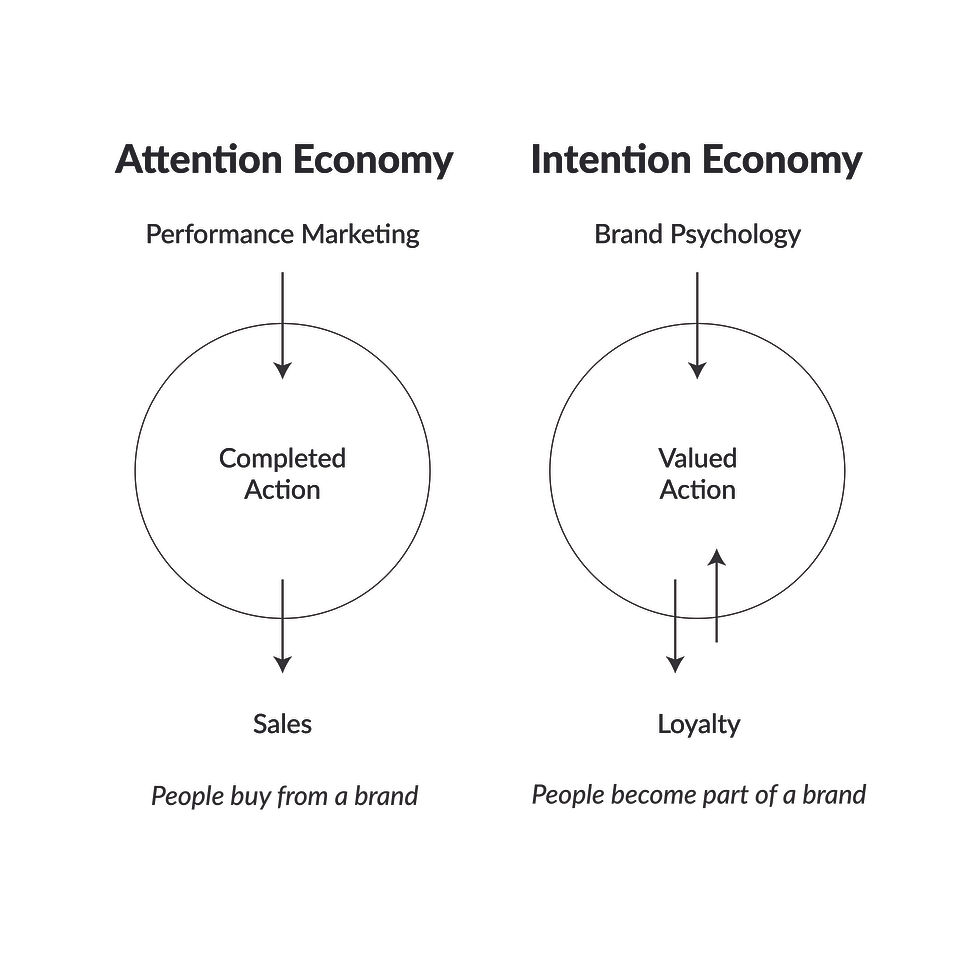
Brand Psychology is not a new discipline; in fact, it’s been happening behind the scenes for years. Brands like Apple, Nike, Patagonia, and the like have been tapping into underlying psychological principles to build unshakeable loyalty and tribe-minded communities. As brand builders, marketers, content creators, and business leaders wrestle with the shift from the attention economy to what some are now calling the intention economy, brand psychology is finally moving to the core of strategy where it belongs. Audiences are now rewarding authenticity over spectacle or performance and actively seeking out brands that offer actualization and shared experiences, making psychology less of an academic curiosity and more of an asset in building brand experiences that last. The beauty here is that it doesn’t require big budgets or award-winning creative; it simply challenges teams to explore the science behind human relationships. Through deep, intentional thinking, and meaning-making, brands can naturally move their audiences from buying their product to becoming part of a brand.
What Brand Psychology is and isn’t
Let’s start by clearing some things up.
Brand psychology is not manipulation, manufactured meaning, or engineered influence. It’s not a toolkit for exploiting cognitive biases or for coercing purchasing decisions. This skewed pop-culture version of brand psychology has been fueled by “neuro”-labeled sales tactics and reimagined advertising takes on classic Cialdini principles. It’s not about pushing the right emotional button or triggering the right mental shortcut; brand psychology is the bridge for creating genuine human connections through aesthetic experiences.
I see real brand psychology as the study of how and why people form meaningful relationships with brands – why they trust some and dismiss others, why they develop loyalty to brands even when there are seemingly better alternatives, and how people have come to rely on brands as identity signifiers in their day-to-day lives. Truthfully, this view of brand psychology has roots in cognitive science, behavioral economics, social psychology, and cultural anthropology.
Design is certainly not excluded here, as taste and aesthetic preferences are the initial drivers that start the conversation. But at its core, brand psychology is about designing for the whole human being. Understanding how people perceive, feel, decide, and ultimately want to belong to something outside of themselves. It means recognizing that purchasing isn’t solely a rational act but actually a choice driven by identity, community, and value association. Brands that connect at that level form bonds rooted in trust and are genuinely deemed worthy of the loyalty that follows.
While this may seem theoretical, I’ve created a framework that organizes and connects these psychological dynamics to ongoing brand development concepts, called the SMART Brand MethodTM. Frameworks like this, and many others, can help brands align with their audiences through clear signals and cultural meaning, while inspiring authentic connection, emotional resonance and social proof through traction. When these 5 elements work together, they create conditions for real, measurable connection, making brand psychology a tangible competitive advantage.
When strategy, story, identity, and experience align in an honest, intentional, and human-centered way, the brand stops being something the company controls and starts becoming something its customers genuinely care about and share.

The Architecture of Meaning and Why Connection is the Point
It’s pretty simple, really; we are meaning-making machines. We don’t just consume products, we construct entire narratives around them. Whether through nostalgic memories of childhood brands, certain coffee shops where we’ve had great conversations, or associations rooted in familiarity and comfort, brands have become vessels for memory, identity, and belonging, and a key part of how we shape our own self-story.
Understanding and designing with brand psychology principles closes the gap between rational thinking and emotional decision-making; balancing the influence between our conscious and subconscious minds. It explains why sensory details matter, like the weight of a package implying quality or a specific smell, feeling like luxury. It explains how brand voice and identity can personify a brand or how some brands become cultural shortcuts for lifestyle choices like Red Bull and Patagonia.
Meaning isn’t something that can be manufactured; it must be lived. Brands that know who they are, what they believe, and why it matters to those on the other side of the experience, know this isn’t a positioning exercise but rather an authentic representation of reality they live every day. They know what they stand for at scale, and when that level of internal clarity exists, customers stop being customers and start becoming participants. They make the brand story their own, become advocates for the brand without being asked, and fundamentally live by the values the brand represents. That’s the architecture of meaning at work and brand psychology intentionally applied in practice.
Trust, Relationships, and the Psychology of Why We Buy
If meaning and connection are the foundation, then trust is the structure built around the brand that sustains its strength and value. Understanding how trust is built (and broken) is perhaps the most valuable use of brand psychology for anyone who leads a brand.
We know from decades of interpersonal relationship research (and personal experience), that trust isn’t granted; it’s earned over time through consistent behavior patterns that tell a reliable story. The same principles apply to brands. Audiences evaluate brands based on how often they deliver on their promises and how consistently they behave across every interaction. A single inconsistency can send a customer spiraling, undoing years of established brand equity, while a single unexpected and surprisingly human moment can create an advocate for life. This means that brands are under constant observation and scrutiny, leading customers to choose or avoid the brands they're exposed to.
Brand psychology helps us map the full journey and design within it, not to engineer a path to purchase, but to ensure that every moment is worthy of experiencing and earning a customer's time and trust. This is why the lifetime value of a customer is so key because the longer a customer engages with a brand at this level, the more integrated they become with the brand. The brand becomes an extension of self through repeated choice, making the act of walking away heavier than simply replacing the product; it becomes an act of self-revision.
Understanding the dynamics and long-term relationship value at play helps brand builders define a roadmap to build trust grounded in real, authentic behavior rather than performative best practices – making
science-backed brand behavior far more valuable than conversion tactics that require the constant re-earning of customer trust.

What Brands Say About Our Identity, Expression, and Long-term Belonging
What our brand choices reveal about us may be the most fascinating part of brand psychology. Shifting the conversation from understanding to expression, brands represent an extension of self and who we aspire to be. They signal to the world (and ourselves) what we value, what we find aesthetically pleasing, who and what we want to be associated with, and how we define our taste. It’s profoundly human if you think about it.
We are not passive targets; we are active participants in a cultural conversation, using brands as vocabulary tools to shape and signal our place, position, and value to others. Brands that genuinely understand this underlying psychological occurrence know that the power lies within the communities they create. These brands listen, grow, and evolve alongside their customers through shared community experiences, becoming what some sociologists might call a cultural resource.
This is the long game of brand psychology, played with intention and integrity, and designed with the human experience at its core.
In Summary …
The era of interruption advertising and performance-only thinking is ending (thank God), and it’s giving way to something bigger, personalized, and more human. Customers no longer settle for face-value signals; they want depth, they want to feel seen and understood, and they want to connect with something real versus being influenced by an algorithm. Brands that understand this desire and design for the “human experience” have tapped into the power of psychological need, social identity, emotional history, and a hard-wired need for connection.
Brand psychology is the discipline that makes that understanding actionable. It bridges the gap between what we know about human behavior and thinking patterns and how we design for exceptional brand experiences. It shifts brand building from intuition to intention informed by human science.
The most important question any brand builder can ask now is “What does it feel like to be in a relationship with this brand?”
When you can answer that honestly, positioning the brand as a human counterpart, and create a experience from that answer, you’ll have built a brand that’s powerful, memorable, and unshakeable in the minds of your audience.


Great insight on how psychology drives brand trust. We see similar identity-signaling dynamics in the digital nomad space - people choose visa paths and destinations that match their self-image. For anyone curious, nomadbriefing.com has practical guides on digital nomad visas and cost of living comparisons.
I have been there more times than I want to admit. The price of XRP is moving, I see an opportunity, and I am sitting there trying to do mental math or juggling three different apps to figure out exactly what my holdings are worth in USD. By the time I get the numbers, the opportunity is gone. It used to be a constant source of frustration. That is when I found the Paybis XRP Calculator. It gives you a real time conversion rate between XRP and USD, so you can see exactly what your XRP is worth at any moment without the guesswork. It also shows a 7 day price history, which is useful for checking recent trends an…
Great perspective on how brand psychology shapes trust and long-term engagement. The same principles apply in gaming too—players stick with platforms that feel familiar and reliable. I noticed similar patterns while exploring the Teen Patti Land App, where branding and user experience play a big role in keeping players engaged. Thanks for sharing these insights!
For years, I managed my supply chain by piecing together different providers, one for storage, another for shipping, and a third for drayage. It was expensive, inefficient, and I spent more time coordinating between them than actually running my business. I knew there had to be a better way. Then I found logistics warehouse at https://pnwwarehousing.com/ and it completely changed my approach. They are a full service 3PL provider based in Washington State with over 350,000 square feet of warehousing space. What really sold me is that they handle everything under one roof, storage, fulfillment, drayage, transportation, and even cross docking. Their facility is customs bonded, FDA approved, and food grade certified, which gives me confidence that they can handl…
I've ordered from several online jacket stores, but Jackets Paradise stands out the most. The quality, comfort, and overall design exceeded my expectations. Fantastic experience.